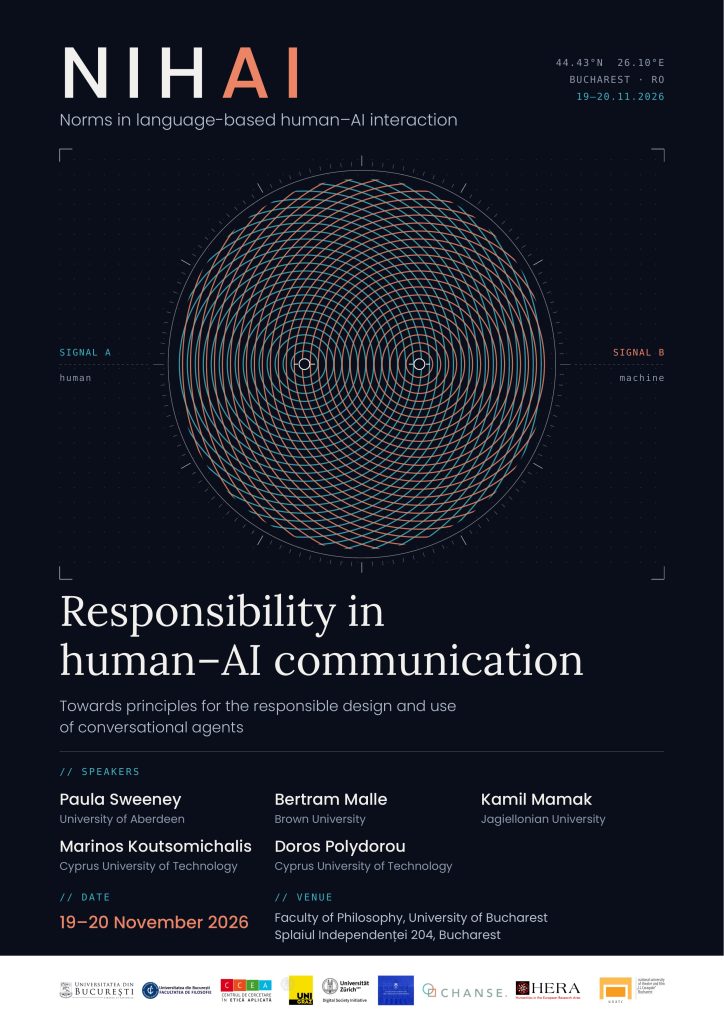
Responsibility in human-AI communication: towards principles for the responsible design and use of conversational agents
University of Bucharest, 19-20 November 2026
Hosted by the Research Centre in Applied Ethics (CCEA) at the University of Bucharest as part of the Norms in Language-Based Human-AI Interaction project, this workshop explores what it means for AI-driven conversational agents to communicate responsibly. People already use chatbots as advisors, assistants and even friends or romantic partners. In this context, it is more and more important to ask what can we expect from them, and who is to blame when they spread false or misleading information. What principles should guide the responsible design of chatbots?
The workshop features talks by Paula Sweeney (University of Aberdeen), Bertram Malle (Brown University), and Kamil Mamak (Jagiellonian University), alongside talks in which project teams from Poland, Austria, Switzerland and Romania present their papers and arguments. Together, the sessions examine responsibility gaps, meaningful human control and blame attribution in human-AI teams, in light of emerging empirical findings from the project.
On the second day, the interactive workshop (A)I do (not?) Care, led by Marinos Koutsomichalis and Doros Polydorou (Cyprus University of Technology), is organised with and hosted by CINETic – International Center for Research and Education in Innovative Creative Technologies at the National University of Theatre and Film „I.L. Caragiale“ (UNATC), as part of the AI in Art Practices and Research Conference 2026.
The program can be accessed here.
Norms in Language-Based Human-AI Interaction
Jagiellonian University, Kraków, 5 June 2026
The conference „Norms in Language-Based Human-AI Interaction” will take place on 5 June 2026 at the Faculty of Law of the Jagiellonian University in Kraków and will explore the ethical, psychological, linguistic, and legal implications of communicating with increasingly human-like AI systems. The discussions will address how future AI platforms should be designed in order to support trustworthy, transparent, and socially responsible communication.
The program can be accessed here. You can register here.
Keynote speakers:
EDOUARD MACHERY (Pittsburgh),
JEAN-FRANCOIS BONNEFON (Toulouse),
MONA SIMION (Oxford),
EMILY SULLIVAN (Edinburgh).
The conference will also feature an applied discussion panel comprising representatives of the European Commission as well as the States taking part in the NIHAI project (Austria, Romania, Poland and Switzerland).
Conference organised by Izabela Skoczeń and Kamil Mamak.
The event is partly funded by the Jagiellonian University’s flagship program Future Law Lab.

Kick-off conference on ‘AI Assertion‘
University of Graz, Austria, June 22-23, 2025. The program can be accessed here.
We are pleased to announce an interdisciplinary conference examining the nature of AI assertion through the perspectives of philosophy, cognitive science, linguistics, and human-computer interaction.
The conference will examine when and how AI systems can be said to make assertions, and how these compare to human speech acts. It will explore whether existing conversational norms apply to AI, or whether new standards are needed. We will address questions of responsibility and accountability in AI-mediated communication, especially in cases of misunderstanding or deception. Finally, the conference will consider how concepts like trust and normativity operate in human-AI interaction, and whether trust in AI language use is meaningful or misplaced.
By bringing together theoretical and empirical approaches, the event aims to clarify how our communicative norms are evolving in response to artificial interlocutors.
INVITED SPEAKERS
Mark Alfano (Macquarie University)
Jean-François Bonnefon (Toulouse School of Economics)
Ophelia Deroy (LMU Munich)
Edouard Machery (Pittsburgh University)
Bertram Malle (Brown University)
Saskia Nagel (RWTH Aachen)
The program can be accessed here.
Online seminar
Beginning in March 2025, we will hold a bi-weekly seminar in which scholars from philosophy, linguistics, computer science and cognitive science will present work relevant to the project. In case you are interested in presenting recent work or attending, please join our mailing list and we will inform you about the call for papers.